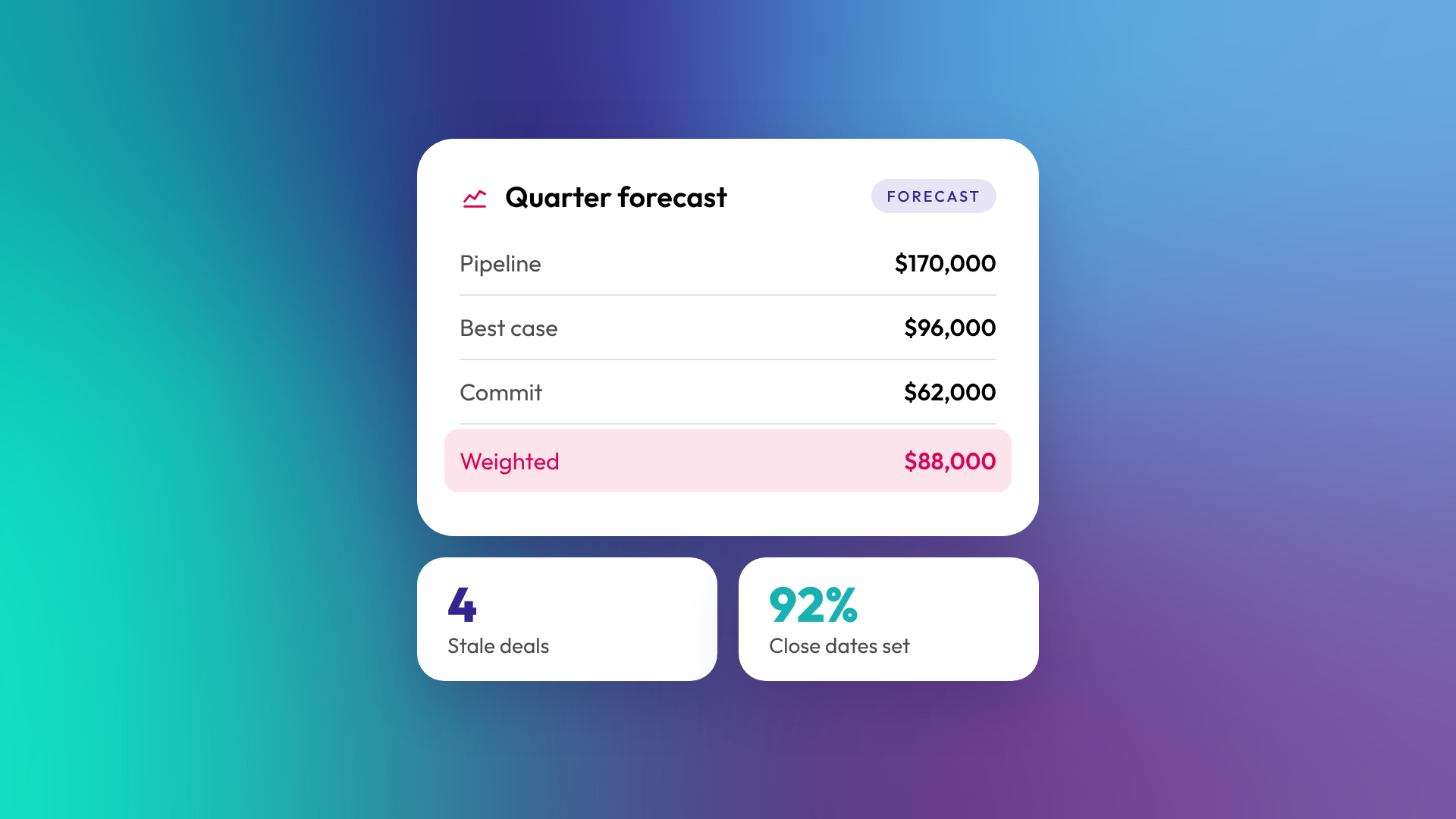
Deal forecasting is the process of predicting how much revenue your sales team will close in a given period, based on the deals currently in your pipeline. A CRM usually forecasts in two ways: by weighting each deal's value by the probability of its stage, and by letting salespeople place deals in forecast categories like Commit or Best case. A good forecast depends far more on clean pipeline data than on the forecasting tool.
How does deal forecasting work?
A forecast looks at open deals expected to close in a period and estimates how much of that value will actually be won. The simplest version adds up deal amounts. A more realistic version multiplies each deal's amount by its likelihood of closing. The most useful version combines that maths with the sales team's judgement about specific deals.
What is a weighted pipeline?
A weighted pipeline multiplies each deal's amount by the probability attached to its stage, then adds them up. A $100,000 deal at a stage with 40% probability contributes $40,000 to the weighted forecast. In HubSpot, each deal stage has a probability, and the weighted amount is calculated automatically.
| Deal | Amount | Stage | Probability | Weighted amount |
|---|---|---|---|---|
| A | $100,000 | Qualified | 40% | $40,000 |
| B | $50,000 | Proposal sent | 60% | $30,000 |
| C | $20,000 | Contract sent | 90% | $18,000 |
| Total | $170,000 | $88,000 |
Weighted pipelines work best when stage probabilities reflect your actual historical win rates, not HubSpot's defaults.
What are forecast categories?
Forecast categories let salespeople say how confident they are about each deal, regardless of its stage. HubSpot's default categories are Not forecasted, Pipeline, Best case, Commit and Closed won, and you can create custom ones. A deal at an early stage might be a Commit because the buyer has verbally agreed, while a late-stage deal might only be Best case because budget is uncertain.
Using stage probability and forecast categories together gives managers both the maths and the context.
How does forecasting work in HubSpot?
HubSpot's forecast tool is available on Sales Hub and Service Hub Professional and Enterprise. Managers set revenue goals for team members, then track progress against them using weighted pipeline or forecast categories. Reps can submit their own forecasts, and managers can adjust. HubSpot also offers AI forecasting through Breeze, which projects future sales based on recent closed-won deals as another point of comparison.
Why are sales forecasts often wrong?
Most forecast errors come from pipeline data, not maths. Deals with old close dates, missing amounts, inflated probabilities or stages that don't reflect reality all distort the number. Optimistic reps and sandbagging reps distort it in opposite directions.
Common causes of bad forecasts:
- Close dates in the past on open deals
- Deals with no amount
- Stage probabilities never updated from defaults
- Deals sitting in one stage for months
- Several deals for the same opportunity
- No agreed definition of what each stage means
How do you improve forecast accuracy?
Fix the pipeline first, then the forecast. Require amounts and close dates at the right stages, define each stage with clear exit criteria, review stale deals weekly, and update stage probabilities from your real win rates once you have a few quarters of data. A short weekly pipeline review, where reps update every deal closing this month, does more for accuracy than any tool.
In OTM's optimisation work, cleaning up deal data and stage definitions is usually what makes a forecast trustworthy enough for leadership to use.
Related reading: What is RevOps? A plain-English definition.
Common questions about deal forecasting
What's the difference between a forecast and a pipeline?
A pipeline is all your open deals. A forecast is your estimate of how much of that pipeline will close in a specific period.
What's a good forecast accuracy?
It depends on your sales cycle and deal size, but tracking forecast against actual each period and narrowing the gap over time is the useful measure.
Should I use stage probability or forecast categories?
Both, if you can. Stage probability gives an objective baseline, and forecast categories add the rep's knowledge of each deal.
Can I forecast renewals separately?
Yes. Running renewals in their own pipeline makes it easy to forecast them separately from new business.
Does HubSpot Starter include forecasting?
The full forecast tool requires Sales Hub or Service Hub Professional or Enterprise. Starter includes some sales reports, but not the forecast tool.
Where to from here
Run a report of open deals with a close date in the past. That number is a quick measure of how far your forecast can be trusted. Our optimisation and support team can help clean up pipeline data and set up forecasting.
